The Only Forward-Looking Signal in Your Enterprise Plan Is Broken
A Conversation with Raunak Singh, VP of Science at Keystone, on Demand Planning, Probabilistic Forecasting, and Supply Chain Optimization
Access the report to get the insights you need to stay ahead
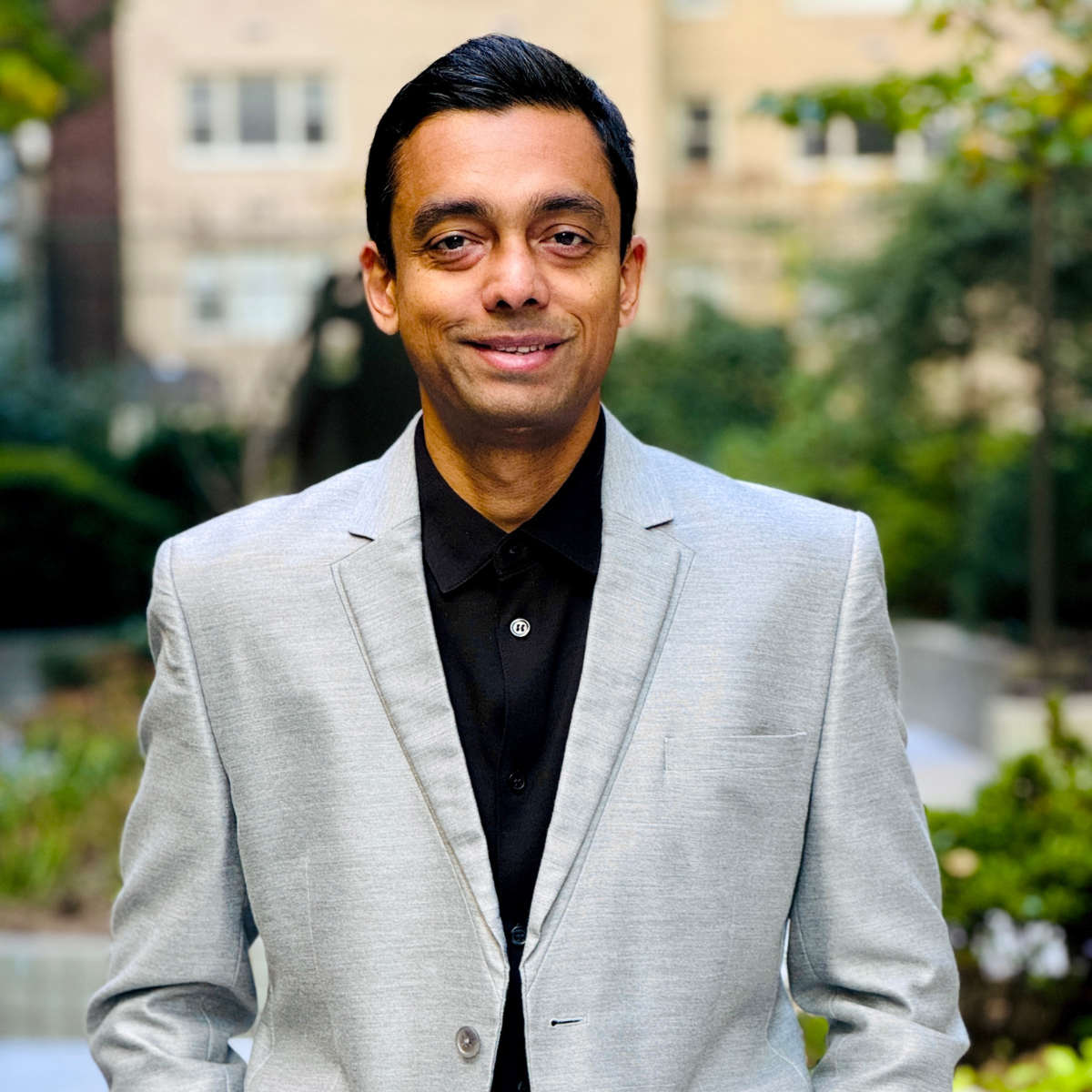
One of the things I appreciate about Raunak Singh is his ability to take a complex concept and make easy to digest. He does it with a smile and without losing any precision.
Raunak leads the science team at Keystone.AI. Before that, he spent more than a decade at Amazon — building and leading the forecasting infrastructure that drives Amazon's global supply chain. In 2017, he was part of the team that deployed large-scale deep learning for SKU-level forecasting at industrial scale, a first of its kind. During COVID, he led strategic capacity planning for Amazon's physical network, presenting forecasts to executives as the company navigated an unprecedented surge in consumer demand.
I was able to get Raunak’s perspective what's broken in forecasting, what excites him about Keystone.AI, and where he sees us change decisions for the better. - Jason Tenenbown
What's the single biggest mistake enterprises make with forecasting?
It comes back to something I've had to remind myself of throughout my career: forecasts are a means to an end. It's easy to get obsessed with improving forecast accuracy — and accuracy matters — but at the end of the day you're trying to improve outcomes. You're trying to make better decisions.
And making good decisions requires more than a single number. Point forecasts are not sufficient. You need to understand the range of outcomes that could happen — the uncertainty around the number. But you would be shocked by how persistently the industry still thinks only in point predictions. Probabilistic forecasts are rarely used to drive real operational decisions, even at very sophisticated companies.
"Forecasting is humbling. You make a prediction every day and then you find out how right or wrong you were. The famous saying is that forecasts are always wrong. You just try to be wrong in less costly ways."
Why does the industry keep defaulting to a single number?
A single number is simpler. It's easier for a human being to reason about. And humans tend to be very sure of themselves — 'I know my business, I know this product line, this is what demand is going to be.' When you push them on their confidence, most people underestimate how much uncertainty actually exists around that number.
But here's what I've come to believe is the deeper problem: it's not a forecasting literacy problem. It's a broken API problem.
An enterprise runs on plans. And the only thing that incorporates real intelligence about the future into those plans is the forecast — everything is encapsulated in it. It's the only forward-looking signal. And that signal is deeply context-dependent. What's broken is that there are very few APIs to inject that context. People don't need to understand forecasting. We need to build systems that can take the context that already exists inside the enterprise and produce more intelligent forecasts from it.
"It's not a forecasting literacy problem. It's a broken API problem. The forecast is the only forward-looking signal in an enterprise plan — and there are almost no mechanisms to inject real context into it."
What are humans actually good at versus machines, when it comes to forecasting?
There's a real asymmetry, and understanding it is important. Time series forecasting models are, at their core, mathematical machines that extrapolate past trends into the future. A model doesn't inherently know if it's forecasting for glass or for tires. It doesn't know you just lost a major customer, or that a competitor is about to launch, or that the macro environment is about to shift. It's myopic by design.
Humans, on the other hand, are genuinely bad at fine-grain forecasting — predicting exactly what a specific SKU will sell two weeks from now. Machines are much better at that. But humans, especially senior leaders who really know their business, are quite good at reasoning about complex dynamics at a macro level. They understand competitor moves. They have strategic foresight. The challenge has always been: how do you harness that kind of enterprise intelligence and actually get it into the model?
That's what AI makes possible. By building the right pipelines — what we call RAIN™ — we translate enterprise context into demand signal in ways that weren't feasible before. Not from throwing a ton of information into a large language model. From ingesting the fine-grain event streams that actually capture how your best customers buy.
"Humans are bad at fine-grain forecasting — predicting what a specific SKU will sell two weeks from now. Machines are much better. But humans are far better at reasoning about complex macro dynamics. The question is: how do you get that context into the algorithm?"
Let's go back to the beginning. How did you get into this field?
I grew up in India, and my undergraduate was hardcore production engineering — working on the shop floor, understanding physical machines, tooling, manufacturing. Very hands-on, grounded engineering.
Then I came to Columbia University in New York to study operations research and industrial engineering, with a focus on large-scale mathematical optimization. My first real job out of grad school was in the airline industry, doing pricing and revenue management. It turns out figuring out how to price airline seats is fundamentally a mathematical optimization problem: you forecast passenger demand, then run an optimization to maximize revenue. So, from day one — even before the term 'data science' existed — I was working at the intersection of prediction and decision.
How did you end up at Amazon?
My manager at the airline software company left for Amazon in 2012. He reached out and said there was interesting stuff happening there. At that time Amazon was deeply invested in the idea of building systems that could make decisions automatically — they believed in it, even though the technology was still early. I went through the interview and joined what was essentially Amazon's version of Groupon.
The first problem they gave me: 'We send 150 million emails a day with daily deals, and we don't know how to order the deals in each email for each customer. Should we send you the massage deal or the skydiving deal?' They were doing it with business rules. I built a model to predict your propensity to click — based on what you'd engaged with before, how far a location was from where you live. Very early machine learning. Very simple linear regression by today's standards. But that's how I made the jump from operations research into what would later be called data science.
And then supply chain became your focus?
I got into supply chain and spent most of the next decade there. I eventually led the forecast team for Amazon's supply chain — everything from fine-grain, SKU-level forecasting that automatically drives inventory placement across Amazon's global network, to what we called top-line planning: strategic forecasting for capacity, infrastructure, and workforce needs years into the future.
One of the things I'm proud of from that period is being part of the team that deployed large-scale deep learning algorithms for SKU-level forecasting at Amazon in 2017. At that time there were research papers on deep learning for time series, but nothing had been deployed at that kind of industrial scale. Seeing it actually transform how supply chain decisions were made — that was remarkable.
Then COVID hit, and I was leading science for top-line planning. Overnight, consumer demand shoots up. The questions became: how big does this physical network need to grow? How many people do we need to hire for fulfillment centers? How many buildings do we need to open? I was in the rooms where those decisions were being made — presenting the forecast, watching executives try to reason about an unprecedented set of uncertainties. Humbling and extraordinary at the same time.
"At Amazon, the most senior leaders believed in decision automation even when it didn't work from day one. They had a vision and they held to it. That long-term conviction was the tailwind. When leadership believes like that, the science eventually delivers."
What brought you to Keystone?
Honestly, the people. There is an extraordinary concentration of talent here — people I'd worked alongside at Amazon, and others I'd admired from afar. That was the initial pull.
But the bigger thing was the opportunity. At Amazon, we had a rare privilege: leadership that genuinely believed in the vision of algorithmic decision-making, and who sustained that belief through years of iteration before it really paid off. That's unusual. Most enterprises haven't had that. Keystone brings the opportunity to bring what I learned from that experience to the broader market — to help other companies make the kinds of decisions Amazon learned to make. That felt like the right next chapter.
And what keeps you here?
The challenge. The fact that nobody has really solved this problem yet.
Even now, with everything that's happened in open source and with AI, the algorithms exist. The math is there. But these systems still aren't widely deployed in enterprises in a way that drives real outcomes. The gap isn't in the science — it's in the system that connects the science to the decision, and in the organizational change required to actually trust and use the output.
At Amazon we were lucky. Leadership believed in it. The challenge at Keystone is helping other companies and their leaders see that same vision, and then actually driving the ROI from it. That is a hard, interesting problem.
"What brought me to Keystone was the people. What keeps me here is the opportunity to solve a problem nobody has cracked: getting enterprises to actually use intelligent, probabilistic forecasts to drive real economic decisions."
What's the most exciting thing you're working on right now?
Building a forecasting system that can ingest fine-grain signals and continuously update its beliefs — in a timely, up-to-date way that reflects what's actually happening in a business. That sounds technical, but the exciting part isn't the technical problem. It's seeing it work with real customers.
There's a concept in AI deployment that I think gets undervalued: the last mile. You can have the best technology in the world. If you can't help organizations understand how to use it — if you can't close the gap between 'the algorithm produces this output' and 'the business makes this decision' — you don't have a product. You have a research project.
What I find genuinely exciting is watching real enterprise clients move from skepticism to understanding to advocacy. Watching a planning team actually start using probabilistic forecasts to make a real procurement decision, a real inventory bet — and seeing that pay off. Watching those people become advocates inside their organizations. That's the most rewarding part of this work.
"The last mile of AI deployment is what the industry doesn't talk about enough. You can have the best technology in the world. If companies can't understand how to use it, you have a research project, not a product. Closing that gap is the work I find most exciting."
Where do you see this all heading?
The vision is agents that can make genuinely intelligent economic decisions inside enterprises — not just automating tasks or reducing clicks, but making decisions that unlock real ROI. For that to work, those agents need a belief about future demand. They need to ingest enterprise context, translate it into better forecasts, and feed those forecasts into economic decision frameworks.
We're building that chain. And what we find is that even before we get to the frontier, enterprises are sitting on fine-grain data and business context they're not using yet. The immediate opportunity is already substantial. The long-term opportunity is transformational.
The AI unlock will come from translating enterprise context into real signal into economically optimal decisions. I think that is the future.