What a Former Treasury Secretary Can Teach Us About Making Decisions Under Uncertainty
Robert Rubin built a decision framework at Goldman Sachs and the U.S. Treasury. It applies directly to supply chain planning.
Access the report to get the insights you need to stay ahead
Every week, a supply chain planning team makes the same mistake. Not for lack of data or software. They fail because they struggle to make optimal decisions that account for uncertainty.
This is not easy. Supply chains are complex ecosystems with bulk commitments — production runs, orders timed to supplier discounts, labor schedules locked weeks ahead. Meanwhile, uncertainty abounds and supply chain planners have to assess many real-time dynamics. For human beings, constantly quantifying uncertainty is hard — we carry bias and can only hold so many things in our heads at once. Making economically optimal decisions to manage that uncertainty is harder. The two are connected — and that connection is where most planning systems break down.
A Practitioner's Framework for Managing Uncertainty and Decision Making
Robert Rubin—70th United States Secretary of the Treasury and former co-chairman of Goldman Sachs—spent decades navigating decisions under irreducible uncertainty. In a 1999 commencement address to the University of Pennsylvania1, he distilled his experience into four principles he carried from Wall Street to Washington.
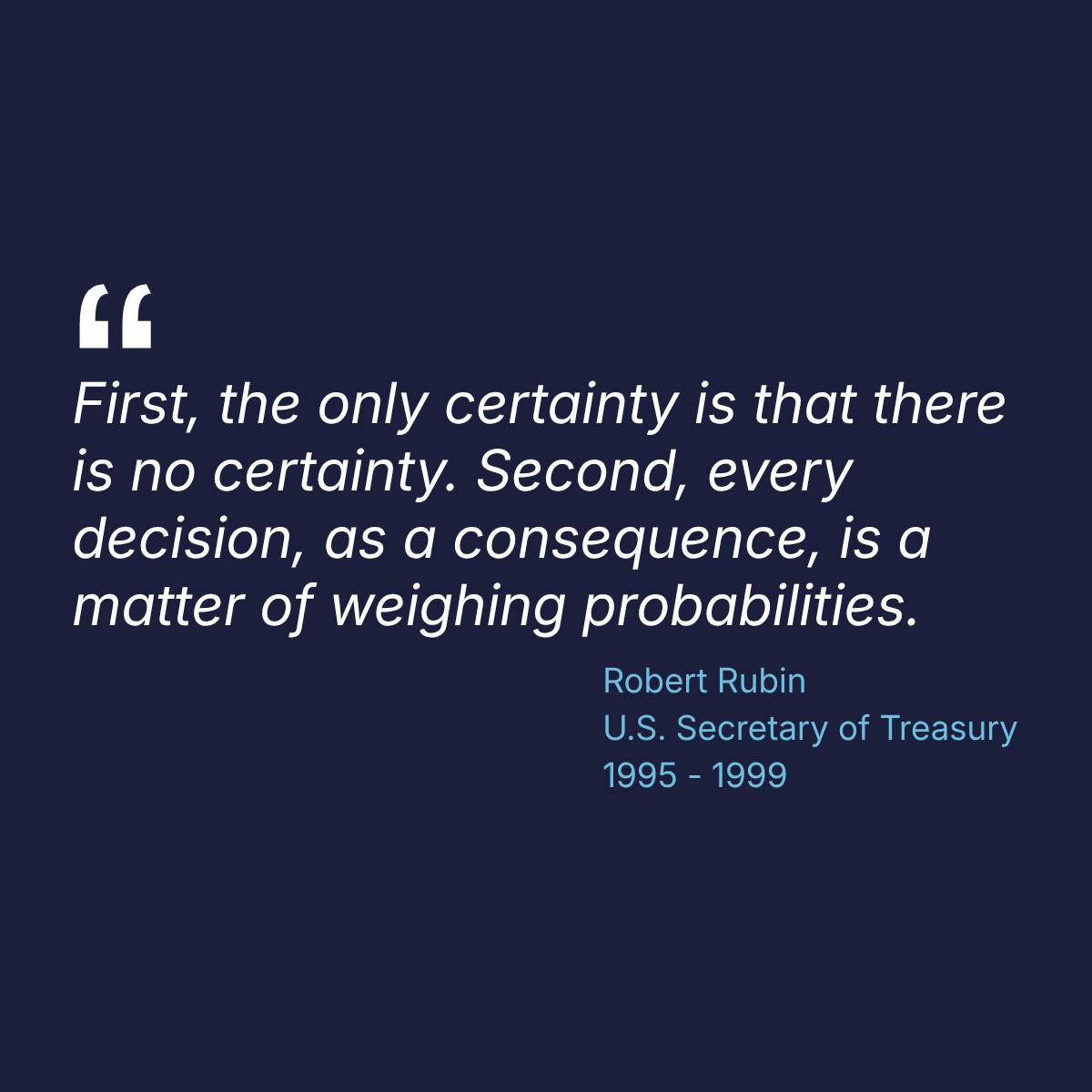
“First, the only certainty is that there is no certainty. Second, every decision is a matter of weighing probabilities. Third, despite uncertainty we must decide and we must act. And lastly, we need to judge decisions not only on the results, but on how they were made.” — Robert Rubin, University of Pennsylvania Commencement Address, 1999
Rubin arrived at the first principle—the only certainty is that there is no certainty—through direct experience. Early in his Wall Street career, he watched a securities trader take an enormous position in a stock because he was absolutely certain that a particular set of events would occur. Rubin examined the same situation. He agreed there were no visible obstacles. But where the other trader was committed to a single outcome, Rubin recognized uncertainty and sized his position accordingly.
Something unexpected happened. The projected events did not occur. Rubin caused his firm to lose money—but not more than it could absorb. The other trader caused his firm to lose money—more than was reasonable. It cost him his job.
That asymmetry—between the cost of false certainty and the cost of calibrated confidence—is the entire framework.
“A healthy respect for uncertainty, and focus on probability, drives you never to be satisfied with your conclusions.... And understanding that difference between certainty and likelihood can make all the difference. It might even save your job.” — Robert Rubin, 1999
Rubin’s four principles map to supply chain planning and decisions—and life decisions—with striking precision.
1: The only certainty is that there is no certainty. If there are no absolutes, then all decisions become matters of judging the probability of different outcomes and the costs and benefits of each.
2: Every decision is a matter of weighing probabilities. Hold your best estimate honestly. State your confidence explicitly. Remain prepared to update when the signal warrants it.
3: Despite uncertainty, we must decide and we must act. All decisions are based on imperfect or incomplete information. But decisions must be made—on a timely basis.
4: Judge decisions not only on results, but on how they were made. In a world where outcomes command all the focus — quarterly accuracy numbers, service levels, fill rates — the discipline of a rigorous process is worth more, not less. A good process with a bad outcome is still a good process. Judging otherwise produces the risk aversion that makes the next decision worse.
Further disciplines are embedded in his framework. Information has value only when it would change the decision. Gather until that marginal value approaches zero—then act. The full commencement address (below) is worth reading.
Two Failures. Two Fixes.
Rubin’s framework reveals two places where current systems break down.
Failure 1: Uncertainty Representation
The Failure: Rubin’s first two principles are unambiguous: certainty does not exist, and every decision is a matter of weighing probabilities. Conventional planning systems violate both—not through bad data, but through the architecture of their forecasts—which are far too often point forecasts.
A point forecast treats a future order as a known fact. When it doesn't carry a full probability distribution, it is pretending there are absolutes in an uncertain world.
The standard response is to add error bands around the point estimate — a symmetric range, drawn from historical error, that says the actual outcome will likely fall somewhere between X and Y. But symmetric error bands do not solve the problem — they decorate it. A customer who delays an order is not the same scenario as a customer who cancels one; planning systems built on point estimates cannot distinguish between them, and cannot respond differently to each.
The Fix: Forecast the likelihood of events — an order, in what quantity, at what time, and how often. A probabilistic forecast answers each part explicitly. It produces a range of outcomes — high-probability scenarios and low-probability ones. That is honest planning.
Failure 2: Signal Effectiveness & Currency
The Failure: Rubin's third principle: gather information until it would no longer change the decision — then act. Conventional forecasting systems fail to gather all available information in two ways.
First, they aggregate order events into weekly or monthly buckets before any model sees the data. In doing so, they destroy the most valuable demand signals in the process.
Consider a large repeat customer who orders 18,000 units every four weeks, very reliably. This should be among the easiest demand patterns to forecast. But by the time the data reaches the model, the weekly buckets show zeros and 18,000-unit spikes. The model smooths these into a 4,500-unit-per-week forecast — and is wrong nearly every week. The error isn't caused by volatile demand. It is caused by a model that never saw the signal because aggregation destroyed it first.
Second, conventional systems do not keep up with real-time signals. A customer who ordered yesterday, a buyer past their reorder window, a large order that just landed — this context exists in your ERP right now. Your forecast has likely not caught up to it.
The Fix: A forecast that ingests every order event at the moment it occurs — before time-bucket aggregation can destroy the signal. Demand is always on. The forecast should be too.
Five Disciplines for Planning Under Uncertainty
Rubin’s framework does not stay in the realm of philosophy. Applied to supply chain planning, it produces five concrete disciplines — properties of any planning approach that takes uncertainty seriously.
1. Uncertainty is the job. A plan sized to a single forecast number is sized for one scenario. Demand does not arrive in single scenarios. Build against a distribution — each outcome with its probability attached.
2. Hold estimates as probabilities. A point forecast does not express confidence— it suppresses it. Every estimate should carry an explicit probability. The question is not what will happen, but how likely each outcome is and what each one would cost.
3. Gather — then act. A forecast that updates on a weekly or monthly cycle is not sensing demand — it is ignoring it between updates. Every order event carries signal. The forecast should update when the signal warrants it, not when the calendar permits it.
4. Inaction has a cost. Staying with a plan that no longer fits reality is a decision — it just does not feel like one. The cost shows up as excess inventory, missed service levels, and trapped working capital.
5. Judge process, not outcome. One bad quarter is not evidence of a bad planning process. Evaluate the methodology: was uncertainty represented honestly? Were signals captured in real time? Were decisions made on probabilities? Outcomes are what you measure. Process is what you manage.
The Pressure Test
Pull your forecast for any top customer and ask: Is it a point estimate? Does it reflect the actual probability of their next order — in what quantity, at what time? Are signals coming in before aggregation and in real time?
If the answer is no, the system is manufacturing false certainty and your team is spending hours in collaborative planning sessions. Your on-hand inventory can be improved without harming service levels.
The Full Commencement
Treasury Secretary Robert E. Rubin Remarks to the University of Pennsylvania Commencement Philadelphia, PA
May 17, 1999
Chairman Vagelos and the Board of Trustees. President Rodin. Provost Barchi. Deans. Faculty. Honored guests. Graduating students of the Class of 1999 -- their families and friends.
Thank you for this honor.
In approaching this commencement address, I'm mindful of an observation made by this university's founder, Ben Franklin. He said: Here comes the orator with his flood of words and his drop of wisdom. I promise not to flood you with words. Whether I leave you with a drop of wisdom is for you to judge.
You graduate today in a world starkly different, in many ways, from the one in which I graduated. It's far more interconnected. Information moves dramatically faster. The decision cycle is vastly shorter. Economies and people around the world are more closely linked than ever before. Decisions made in one capital can be felt across the globe.
Business today is conducted largely without borders. When I first went to Wall Street, more than 32 years ago, finance, for example, was focused on the U.S. markets. We sold U.S. stocks and bonds to our clients and raised money for them in U.S. capital markets. Few overseas markets mattered. Even the biggest U.S. companies had but a limited overseas presence. Now, Fortune 500 firms are headquartered in the U.S. but are truly global in nature.
When I first joined an investment bank, I had to get a partner's signature to make an overseas call. Today traders live on global trading wires, and capital markets are integrated worldwide.
Global markets and technology have brought us together as never before. Pick up a newspaper and you'll find exchange rates for the Thai Baht and Korean Won -- currencies few people worried about when I began my career. Countries that were economically irrelevant to us 25 or 30 years ago, today provide great opportunities for American businesses and consumers. But, as demonstrated during the past two years, these same nations can also give rise to financial instability that can threaten economies around the world, no matter how strong.
Last year, for example, Russia's failed economic policy actions shook global market confidence -- and other countries felt the impact. A Latin American finance minister explained this dilemma to me last year. How, he asked, do I explain to my people why the value of our currency is shrinking and our interest rates are rising, all because the Russian parliament failed to raise taxes last week. This may sound unusual, but its true.
This interdependence isn't just in economics. Today we must deal with immense problems in other areas that begin in one nation but affect many others. Many of these are problems that no single nation can solve: Environmental problems, such as destruction of the rain forest, that can damage the atmosphere of the entire globe, or acid rain. Health problems, such as the startling incidence of HIV in the Sub-Saharan Africa population, that can spread so readily in an era of jet planes. And terrorism, nourished by despair in one country, with its consequences felt around the world.
Whether we meet these challenges of interdependence, and of the tension that exists between the sovereignty of nations and the need to work together to solve problems that have no borders, will shape the world you live in.
In the face of these realities, there are those who believe we should look inward and withdraw from the world. I believe the whole history of the twentieth century shows that this will not work. We would follow this advice at our peril. The world does not end at our shores -- it begins there.
In the complex world of today, decision making has become ever more difficult, but the fundamentals of decision making have remained the same. And, one lesson I can draw from my life is that effective decision making is the key to almost everything you will do.
When I arrived at college, I had never given much thought to how I made decisions. College began changing that. What first struck me was the skeptical atmosphere. Our professors' words weren't seen as unquestioned truths, but as starting points for criticism and thought. In my sophomore year, I took Philosophy I from a wonderful, elderly professor named Raphael Demos. His whole point was to show that every assertion ultimately rested on a basic principle that could not be proven. It could only be assumed or believed. That conclusion, together with what I learned in law school, fundamentally shaped the way I've made decisions ever since.
As I think back over the years, I have been guided by four principles for decision making. First, the only certainty is that there is no certainty. Second, every decision, as a consequence, is a matter of weighing probabilities. Third, despite uncertainty we must decide and we must act. And lastly, we need to judge decisions not only on the results, but on how they were made.
First, uncertainty.
When my father was in college, he too had signed up for a course in philosophy with a renowned professor. On the first day of class, the professor debated the question of whether you could prove that the table at the front of the room existed. My father is very bright and very pragmatic. He went to the front of the room, pounded on the table with his hand, decided it was there -- and promptly dropped the course.
My view is quite the opposite. I believe that there are no absolutes.
If there are no absolutes then all decisions become matters of judging the probability of different outcomes, and the costs and benefits of each. Then, on that basis, you can make a good decision.
The business I was in for 26 years was all about making decisions in exactly this way.
I remember once, many years ago, when a securities trader at another firm told me he had purchased a large block of stock. He did this because he was sure -- absolutely certain -- a particular set of events would occur. I looked, and I agreed that there were no evident roadblocks. He, with his absolute belief, took a very, very large position. I, highly optimistic but recognizing uncertainty, took a large position. Something totally unexpected happened. The projected events did not occur. I caused my firm to lose a lot of money, but not more than it could absorb. He lost an amount way beyond reason -- and his job.
A healthy respect for uncertainty, and focus on probability, drives you never to be satisfied with your conclusions. It keeps you moving forward to seek out more information, to question conventional thinking and to continually refine your judgments. And understanding that difference between certainty and likelihood can make all the difference. It might even save your job.
Third, being decisive in the face of uncertainty. In the end, all decisions are based on imperfect or incomplete information. But decisions must be made -- and on a timely basis -- whether in school, on the trading floor, or in the White House.
I remember one night at Treasury, a group of us were in the Deputy Secretary's Office, deciding whether or not the U.S. should take the very significant step of moving to shore up the value of another nation's currency. It was, to say the least, a very complicated situation. As we talked, new information became available and new considerations were raised. The discussion could have gone on indefinitely. But we didn't have that luxury: markets wait for no one. And, so, as the clocked ticked down and the Asian markets were ready to open, we made the best decision in light of what we knew at the time. The circumstances for decision making may never be ideal. But you must decide nonetheless.
Fourth, and finally, judging decisions. Decisions tend to be judged solely on the results they produce. But I believe the right test should focus heavily on the quality of the decision making itself.
Two examples illustrate my point.
In 1995, the United States put together a financial support program to help Mexico's economy, which was then in crisis. Mexico stabilized and U.S. taxpayers even made money on the deal. Some said that the Mexico program was a good decision because it worked.
In contrast, last year, the U.S. supported an International Monetary Fund program designed to strengthen the Russian economy. The program was not successful and we were criticized on the grounds the program did not succeed.
I believe that the Mexican decision was right, not only because it worked, but also because of how we made the decision. And I believe the Russian decision was also right. The stakes were high, and the risk was worth taking. It's not that results don't matter. They do. But judging solely on results is a serious deterrent to taking the risks that may be necessary to making the right decision. Simply put, the way decisions are evaluated, affects the way decisions are made. I believe the public would be better served, and their elected officials and others in Washington would be able to do a more effective job, if judgments were based on the quality of decision making instead of focusing solely on outcomes.
Time and again during my tenure as Treasury Secretary and when I was on Wall Street, I have faced difficult decisions. But the lessons is always the same: good decision making is the key to good outcomes. Reject absolute answers and recognize uncertainty. Weigh the probabilities. Don't let uncertainty paralyze you. And evaluate decisions not just on the results, but on how they are made.
The other thing I'd like to leave with you is that you will be entering a world of vastly increased interdependence -- one in which your lives will be enormously affected by decisions made outside of our borders. We must recognize this reality and reject the voices of withdrawal to face the challenges of interdependence. Then, we can realize the immense potential of the modern era, for our economy and our society.
You've just completed an important milestone in developing your ability to deal effectively with the complex choices of the world in which you will live and work. By continuing to build on this foundation throughout your life, you will be well prepared for the great opportunities and challenges of the new century.
Congratulations and good luck.
1 Robert E. Rubin, remarks to the University of Pennsylvania Commencement,Philadelphia, May 17, 1999. Archived content, U.S. Department of the Treasury.